Observability is the control layer for CX. Enterprises want customer experiences that are more seamless, more performant, and more enjoyable, built from the right combination of AI and human touch. AI execution and human judgement together deliver the best end to end experience, and observability is what monitors, diagnoses, optimize's, and governs both as they work side by side.
At Operata, we believe that human judgement and AI execution unlocks the best end-to-end CX.
Overture adds depth and scope to CX Observability across AI and human agents. Every AI interaction is now recorded on the same journey as the human agent it hands to, and measured against the same standards.
Overture delivers across three areas
Expanded Customer Journey Trace
The trace now runs from the first AI turn through to the human agent who takes the call.
Service level views and dashboards
AI agents, human agents, and remote teams reported against the same standards, in one set of service views.
Builder experience
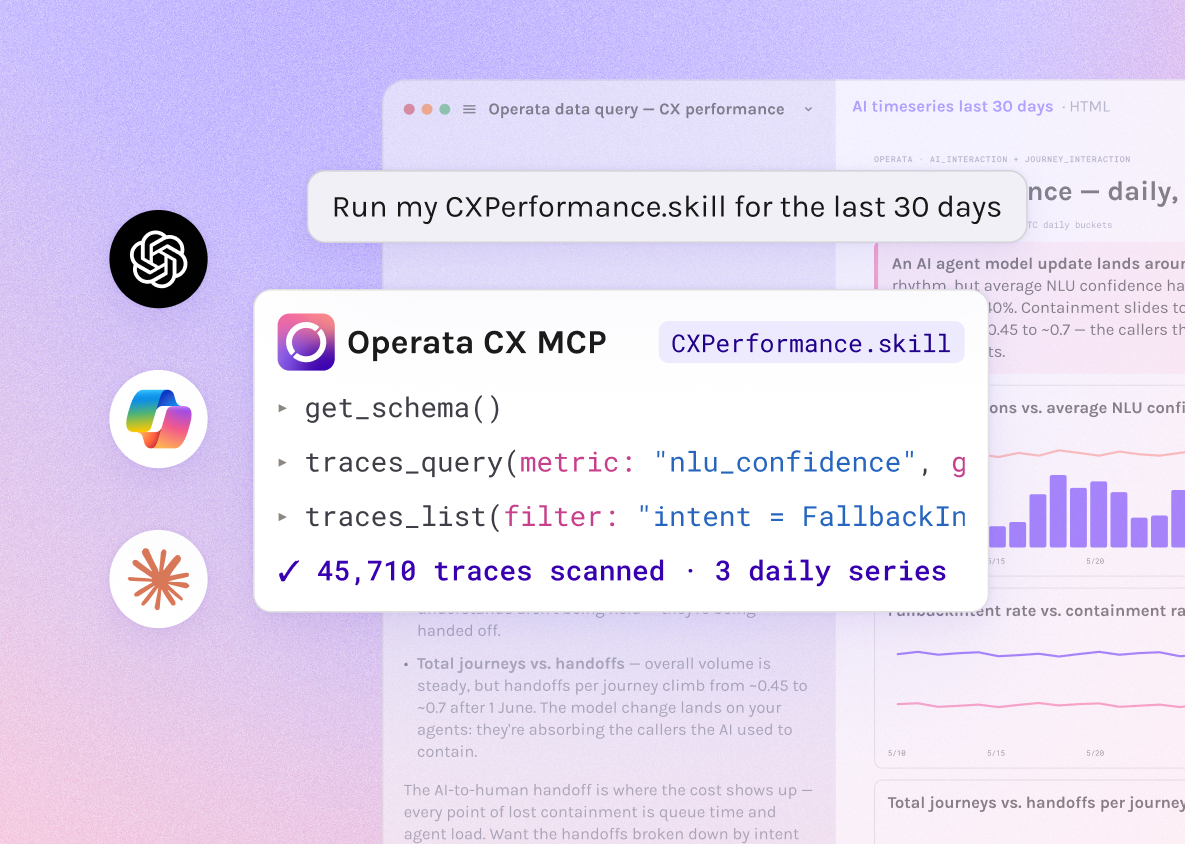
Your CX Observability data, with supporting docs and CX knowledge, available over MCP to build against, alongside the other connectors your team already runs.
What you can do with it
Journey visibility
See the entire customer journey
From the AI, through queue placement, agent handling, transfers, and resolution.
Catch failures as they happen
Every production call is monitored, issues surfaced before customers find them.
Track API and tool latency failures
Errors and slow responses from internal or third party APIs that affect the customer.
Containment truth
Understand AI to human handoffs
Classify successful completions, quantify containment, and see why each one happened.
Verify containment data
Disconnect reason, intent state, NLU confidence, queue events, agent interaction, hold time.
Prevent queue misroutes
Legitimate escalations separated from misroutes, with transfer rate in the context of intent design.
Continuous improvement
Reduce repeat interactions
Repeat and failed self service interactions identified, with what they have in common.
Optimize AI agent changes
Issues in NLU, utterances, and intents surfaced, and changes measured against CX.
Iterate and improve
Performance measured across every second, every service, every customer journey.
The Customer Journey Trace, expanded
The Customer Journey Trace is the only end to end multi vendor observability layer built for CX. By tracing and linking customer journeys across AI agents, handoffs, and human agents, IT and Ops teams can assure, monitor, diagnose, and improve performance throughout their CX environment.
Operata captures the metrics, traces, and logs from every service that delivered the interaction, and normalizes them into an OpenTelemetry convention Operata designed for CX. That is what stitches a journey into one record across any service.
The trace now runs from the first AI turn through to the human agent and back, so a call that crosses telephony, voice AI, IVR, tool calls, queues, transfers, and the network is one timeline. Every span opens to the attributes, metrics, logs, and latency beneath it.
New in this release
AI turns and intent.
What the AI understood on each turn, the intent it assigned, and the path it took to get there.
Conversation turns and transcript.
What both parties said, with a summary of the conversation and its outcome.
Guardrails.
Which guardrails triggered, and where in the conversation.
Voice AI media quality.
The audio the AI agent itself received, because an AI agent cannot serve a customer it cannot hear.
Tool calls.
Every call the AI makes to internal and third party APIs, with the latency and result of each one. A timed out tool call can leave the customer listening to dead air for fourteen seconds.
The AI to human handoff.
Audio quality, whether context passed, duration, and drop events, captured at the moment the AI transfers to a person.
Alongside what the trace already captures
Telephony legs.
Both of them, the leg into the AI agent and the leg into the CCaaS environment on transfer.
IVR, queue, and agent handling.
The route the call took, time in queue, the routing events behind it, and the handoff once an agent connects.
Transfers, mutes, and holds.
Each transfer, the context carried across it, and the duration of every mute and hold event.
The agent environment.
Handle time, hold, mute, customer activity, and sentiment, plus CPU load, network quality, headset, and browser on the agent's machine. Captured by the Agent Collector, including the issues agents report themselves.
WebRTC and network quality.
Audio quality, packet loss, and jitter, down to the agent's last mile, the carrier, and the media path.
Insights.
Operata classifies the interaction and flags where the customer experience was compromised, on the agent side and the customer side.
The trace is written while the call is live, so a failed tool call or a dropped handoff is on the timeline before the call ends. Click a span, see what happened at that step.
The AI layer can look clean while the fault sits upstream of it. Tool call errors, missed intents, and an agent who cannot hear the customer can all trace back to packet loss on the telephony leg, a layer above anything the AI vendor can see. The same trace shows whether the AI disclosure reached the customer at all.
Service level views and dashboards
Where the trace records one interaction, service views report across all of them. AI agents, human agents, BPO, and remote teams, measured the same way.
Key performance metrics and insights.
Performance surfaced by service view, with the insight that goes with each metric.
Verified containment.
The vendor's self reported figure alongside the evidence underneath it: disconnect reason, intent state, NLU confidence, queue events, agent interaction, hold time.
AI agent optimization.
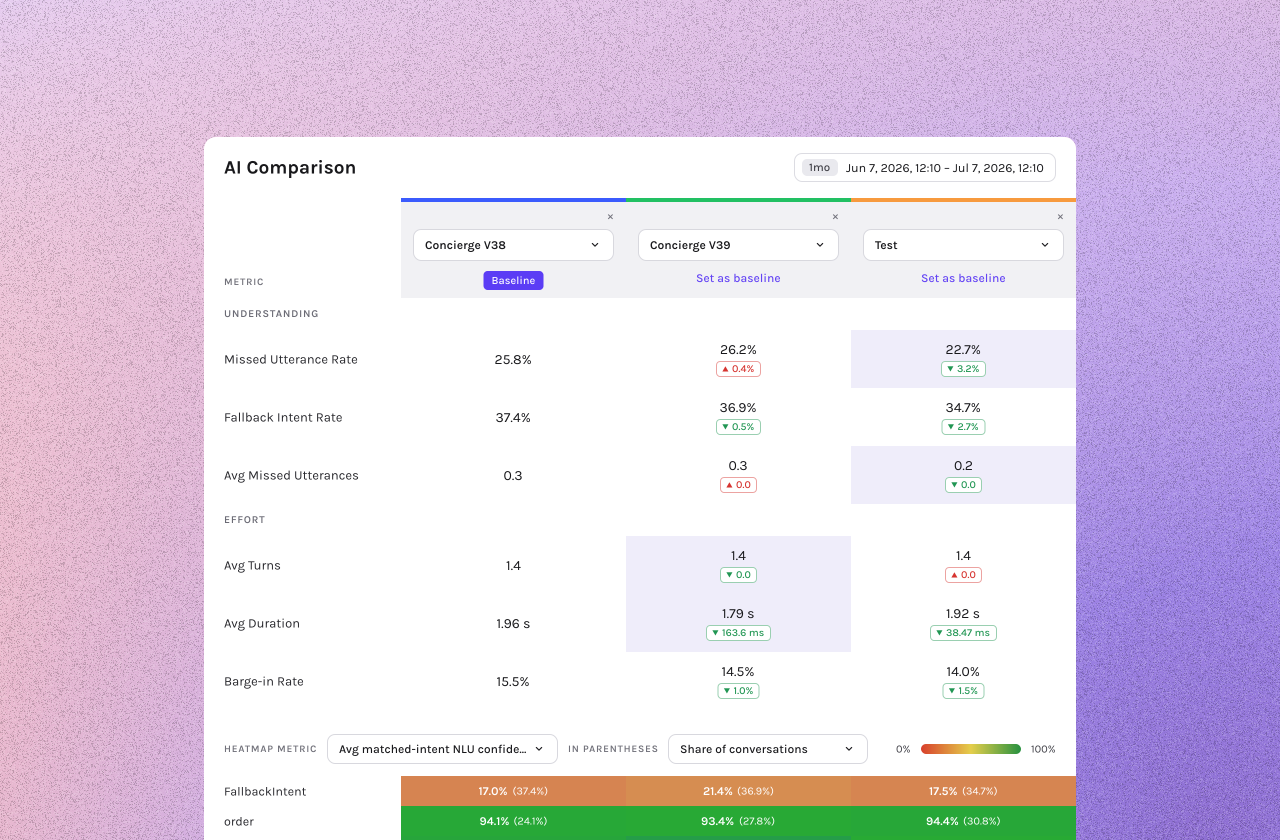
Slice AI conversations by intent, NLU confidence, and version, then compare cohorts on containment, escalation, resolution, transfer abandons, and repeat calls. Same trace, every cohort. Pick a version, pick a cohort, see the delta.
Transfer analysis.
Transfer rate in the context of intent design, with designed escalations separated from misroutes. Shows which intents, which AI, and which points in the flow are leaking callers to human agents.
Repeat and failed interactions.
Repeat contacts that follow interactions the AI marked complete, with the technical signature shared across them.
Voice AI performance.
Operational metrics per voice agent, including customer effort, with the tool calls, errors, and handoffs that affected the experience.
Unresolved intent analysis.
Where the voice agent could not resolve the intent, the events downstream of it, including the queue the call finally landed in, show what the customer actually wanted. Map that back into the agent design.
Human agent estate.
Network quality trends by ISP, region, country, and network type, which surfaces problems beyond an agent's home setup. Headset and audio device metrics, with non compliant devices flagged to the agent. Browser versions and hardware load during calls.
Live monitoring.
Every production interaction is reported as it happens, so a breach shows while there is still time to act on it.
The builder experience
Operata's data is available to build against, with a knowledge base alongside it.
Tenor, your CX expert.
Operata's knowledge base is built from millions of monitored minutes and thousands of investigations. It holds the definitions, the thresholds, what a failure signature means, and how to escalate it to a carrier. Tenor runs the knowledge lookup and the trace queries in the same step, so a vague, non technical question comes back with a root cause rather than a chart. IT, Ops, and human agents all work from the same answer.
One query, every affected layer.
Packet loss on a carrier trunk can show up as degraded audio, as low bot confidence, and as an AI disclosure the customer never hears. One query returns all of it, carrier, media, AI, and compliance, where each would otherwise be a separate tool and a separate team.
Evidence packs.
The evidence for a carrier or vendor escalation, assembled from the same data.
Build what your process needs.
Operata data works alongside the other connectors your team already runs, so the workflow is something you compose rather than something you wait for. Route it into incident management, collaboration channels, ticketing, or your own services, and trigger whatever the process calls for. One example: a P1 raised and assigned in PagerDuty with the full detail, the same incident posted as a single card in Slack, and the relevant runbooks attached to both, so whoever wakes up to it knows what to do before they open a laptop.
Available two ways. Tenor sits inside the Operata platform. The Operata MCP server connects the same knowledge and telemetry to Claude, ChatGPT, Microsoft Copilot, Cursor, or your own agents over one open standard.

One standard across vendors
Operata sits outside the vendor stack and measures any voice AI and CCaaS mix on the same metrics.
Verified integrations ship out of the box, including AI Collectors, Cloud Collectors, and Agent Collectors. See what is verified on the integrations page.
Operata has architectural support for more than 50 voice AI, voice CX, and CCaaS platforms. Applied Engineering provides full integration support, included in any implementation program, and can verify any listed platform on request.
Governance
Operata is not a governance platform. Risk assessments, policies, review boards, and sign offs stay with you. What this release adds is the evidence underneath them, for the AI layer.
Every interaction is monitored for the failures on your risk register: misread intents, dropped context, silent timeouts, dead end escalations. The trace holds what the AI heard, matched, and decided. It shows where the handoff happened, whether context survived it, and whether a human stepped in when one should have. Baselines and version comparison show the AI still clears your bar, release after release.
The EU AI Act's transparency duties apply today, and accountability sits with the enterprise. Operata records whether the AI disclosure was audible to the customer, not just whether it played.
Available now
CX Observability for AI Agents is available across supported platforms. Verified status for an individual platform follows Operata's standard verification process and can be requested by customers or partners.
About Operata
Operata is the leading provider of CX Observability, giving enterprises the tools to measure, manage, and optimize customer experience across the full CX stack, from AI agents to human contact center teams.
Headquartered in Denver, Colorado, and Melbourne, Australia and trusted by Global 1000 brands, Operata helps organizations deliver better connections by transforming observability into a shared language across IT, Operations, Data, and AI teams.
Overture is the opening movement of an opera, the piece that introduces the themes of everything that follows.