Tenor is your AI engineer for CX. It’s Operata’s agentic layer that reads the technical, operational, and experience signals behind every customer interaction. What comes back is the answers and actions you need, grounded in your CX Observability data.
This release extends Tenor from the platform UI to Operata’s Model Context Protocol (MCP) server, with new insights and actions for your teams and your own AI agents. A conversation moves with you, tells you when its answer is ready, and keeps running when you step away or start a new chat.
Measure, benchmark and build performance across CX technology and operations
Use Tenor to track your CX technology and operations against your own history and benchmarks.
Tenor answers questions about performance across agents, queues, calls, and networks, and compares the result with a baseline. In the example below, Tenor checks each agent’s hold-to-talk ratio against the overall average, compares it with the previous 7 days, then drills into the calls behind it.
Ask Tenor for recommendations on what to fix, which issues are trending, and how operations perform, drawn from your historical CX Observability data.
Expand AI SREs to CX for autonomous resolution
Feed Tenor’s CX knowledge and CX Observability data to the AI SRE you already run, like Datadog® Bits AI, AWS® DevOps Agent, or Resolve AI™, to cut time to detect (MTTD) and time to resolve (MTTR).
Tenor draws on CX knowledge shaped by experts who built enterprise-scale customer experiences. It knows the definitions, the thresholds, what a failure signature means, and how to escalate it to a vendor.
This knowledge travels with the data. An AI SRE working a contact center incident gets CX context alongside the metrics, traces, and logs Operata captures from every AI agent, human agent, and service in an interaction. Operata correlates them in OpenTelemetry traces for your AI SRE to ingest.
Build live dashboards and reports with Tenor and your AI
Use CX Observability data and Tenor insights in the AI tools you already work in, including Claude, ChatGPT, Copilot, Cursor, and more.
Tenor builds charts from your data inside the platform. Operata MCP gives your own AI the same data. Pull it into a BI tool, or ask your AI to chart it, and the numbers come from the same source Tenor uses.
It runs alongside the other connectors an agent uses, such as PagerDuty, Slack, and your ticketing system, so a question about your data finishes in the system where the work gets done.
In the example below, a question about telephony errors affecting bot confidence and audio quality returns the affected calls, MOS, packet loss, and the trunk involved. It ends with a P1 raised in PagerDuty and posted to Slack, with the evidence and runbooks attached.
Learn more about the builder experience and the Operata MCP server.
Know what’s happening in production right now
A live view across your CX estate shows what is alerting, what has changed, and which team owns it, including the handoff from AI agents to humans.
Tenor reads the metrics, traces, and logs Operata captures from every AI agent, human agent, and service behind an interaction. Ask a question, and Tenor queries your data, reads the result, finds the context, and correlates it across the journey.
Whether you start from the homepage or the dedicated page in the nav, there is no need to begin with a blank box. The prompt library gives IT and Ops real questions to begin with, grouped by agent behavior, call quality, network and devices, and trending issues. Pick the one closest to what you are investigating, then edit it to suit.
Sharp diagnostics. Built for CX.
Our own CX Knowledge Graph and the best frontier models, combined by an architecture built to get the one correct answer specific to the CX technology domain.
Tenor works toward the root cause. A question about a call returns the root cause and the next step, so you act on a diagnosis, not raw data.
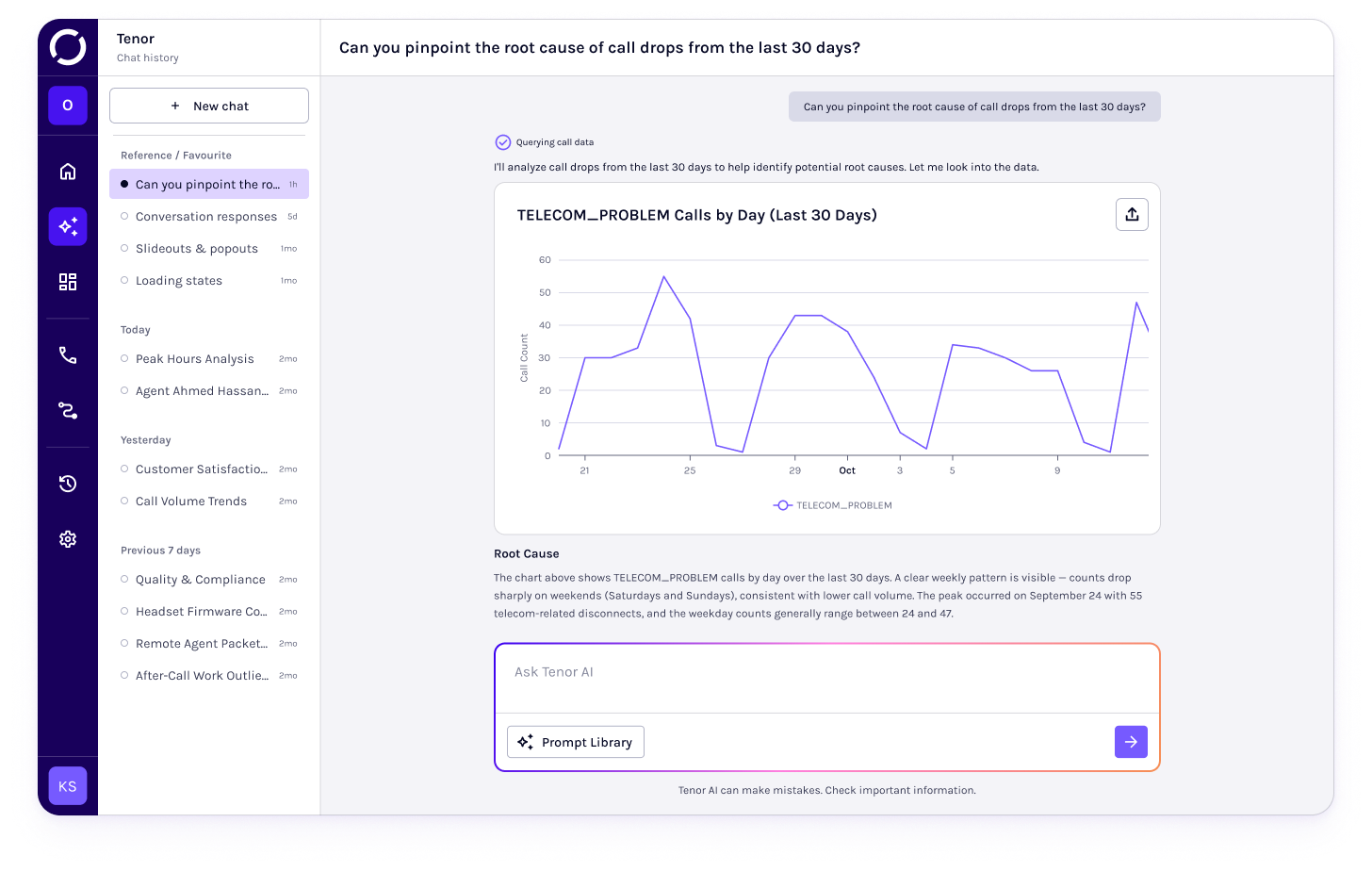
Every answer links to the documents Tenor used, so you check the evidence before you act. Each answer also suggests follow-ups, so one question opens the next.

Owns the production results that matter
Faster mitigation, higher root-cause accuracy, more productive IT and Ops engagement.
These updates make Tenor easier to work with for everyday queries and prompts, so investigations keep moving.
Tenor keeps working while you move on. Ask the next question while the first runs, or close the window and step away, and Tenor finishes the answer and saves it to your history. Status indicators show which answers are still running and which are finished.
If an answer heads the wrong way, press Stop, so a long one never holds up the next.
Powered by AI you can trust
Because Tenor now runs in more places, the same controls follow it everywhere. Tenor is grounded in the CX Observability data behind your enterprise, run on Anthropic Claude models through Amazon Bedrock. Your prompts, and Tenor’s responses, are never used to train or improve AI models. Operata’s own models for anomaly detection and CX Risk Scores run inside our infrastructure.
Our purpose-built agents use Claude models to query your data, summarize findings, build charts, and recommend next steps. Tenor works from logs, events, and performance metrics. All AI features inherit the security controls of the Operata Cloud Service. Operata maintains SOC 2 Type II and provides the evidence your GDPR, CCPA, and EU AI Act reviews require.
Tenor inherits Operata’s platform security: encryption in transit and at rest, role-based access, and regular independent testing.
Available now
The new page is live in the Operata platform. Open it from the side nav, or start on the homepage. Learn more in the Tenor documentation.
For more ways teams use Tenor, see Tenor for IT, Tenor for Ops teams, and Tenor for human agents.