This website or its third-party tools use cookies, which are necessary for its functioning and required to achieve the purposes illustrated in the privacy policy. You accept the use of cookies by closing or dismissing this notice, by clicking a link or button or by continuing to browse otherwise. Learn more
Personal AI agents will change how your customer experience runs.
Personal AI agents never get bored, never hang up and never fill in a survey. Here's what that does to your contact center, and why your dashboard won't see it.
AI Key Takeaway
Personal AI agents such as Meta's Muse, OpenAI's Dots and Instinct can now contact businesses for consumers to cancel subscriptions, chase refunds and dispute bills. Luke Jamieson draws on his years running contact center operations to set out five impacts. First, the caller is no longer the customer, so sentiment, CSAT, QA and identity checks end up measuring the AI agent. Second, demand rises because contacting a business no longer takes any effort. Third, only the hard calls reach human agents, which raises burnout and removes the entry-level path new starters used to learn on. Fourth, context gets lost across two handoffs, and the customer acts on a summary from their own agent that the business never sees. Fifth, Erlang-based forecasting breaks, because scheduled agents arrive in steps rather than curves and never abandon. Standard metrics will misread all of this: abandonment falls, AHT climbs, repeat contacts rise and hardship flags magically disappear. The article argues that CX Observability is the foundation for a response. It lets an organization tell human callers from AI agents on every interaction, which means it can answer two questions: what share of contacts are AI-initiated, and what those agents are doing.
Meta launched Muse, OpenAI launched Dots and Instinct went from what felt like a viral demo to mainstream normality in a matter of weeks! Personal AI agents can get stuff done on our behalf, rather than just answering questions, and are now a consumer product which has generated a lot of speculation about what that will do to contact centers. Having spent the last couple of decades in and around contact centers, I thought I would weigh in with a few things I am not sure have been considered yet.
Let’s play out what this could look like. A customer tells Muse to cancel a subscription and then goes off to make a coffee. Their agent calls your contact center, sits through the hold music, quotes clause 14 of your terms to the person who answers, declines the retention offer twice, and at the conclusion of the call sends its owner a two-line summary. The customer never heard your brand name, never spoke to your agent, and won't ever fill in the CSAT or NPS survey. In your reporting, that interaction was a call, a cancellation and a survey non-response. Multiply it by a few thousand a day and most of what a customer service focused organization believes about its customers, stops being true.
Most of what I have read so far covers the customer's side of this, and the AI layer a business will need in order to meet those agents.
I spent years running contact center operations, so that is the view I am writing from. From that lens, a few things look like they have not been thought through yet: the people who will take the calls the AI agents cannot settle, the way you forecast and staff, and the reports you use to know how things are going. All of that was built for human callers, who have limited patience, busy lives and who know and care very little about your policies. None of which is a problem for a personal AI agent.
What a personal AI agent changes for the customer
The pitch for personal AI agents is that you hand over the jobs you dread: canceling a subscription, chasing a refund, arguing a bill, and sitting on hold, allowing you to get on with your day. The agent does all the waiting, the asking and the asking again when the first attempt fails, and on top of this it does not get bored, frustrated or run out of time.
Most of how a contact center manages demand assumes a human on the other end with a finite amount of patience and time. Queues work because people weigh the wait time and effort against the value of the call and likely outcome. It is a natural filter. Retention conversations work because a customer will often take a fair offer and move on because the effort to find and test a competitor is also more time and effort. And self-service, IVR’s, FAQ's, websites, processes, and policies were all designed around how people behave; however, an AI agent doesn't behave the same way humans do. Aside from tokens, an AI agent has an unlimited supply of patience and time, and it compares your offer against every competitor while it waits.
Five impacts on the operation
Here are five things I have been thinking about, that may not have been considered just yet.
Impact 1: The caller is no longer the customer
Almost everything a contact center measures assumes the caller and the customer are the same entity. When I was working in contact centers, there would on very rare occasion be a scenario where a famous person or a CEO of a large company would contact the contact center via their human personal assistant. It would always wreak havoc on things like security checks and processes. The privilege of having a personal assistant was afforded to very few people so it wasn't common practice. However this privilege is now available to everyone and contact centers will soon find that this is not the exception but the rule.
Personal AI agents also go a step further than a human personal assistant because emotion, time and patience play no part in the interaction.
Currently, sentiment analysis reads the caller's tone, CSAT asks the caller how it went, QA scores rapport with the caller, and identity checks depend on the caller's voice and personal and account details only the caller knows. Put a personal AI agent on the line, and every one of those measures is now reading the AI agent, not the customer it represents. The survey goes to a customer who never spoke to you. Sentiment is scored on a synthetic voice. Passing authentication proves only that the agent was programed with the answers, and says nothing about whether the account holder authorized this task. The signals you are attuned to hear, distress, confusion, hardship, are filtered out by a calm, capable intermediary who has none of them.
Impact 2: Demand rises because contacting you costs nothing
For as long as contact centers have existed, the effort of making contact has acted as a natural filter. On plenty of occasions I have had a legitimate refund, a fee that could be waived or a better plan that I was eligible for, and never called because twenty minutes on hold was too high a price or I was simply too busy (or lazy). That is what I call potential demand for a contact center. It was always there but for one reason or another never eventuated. A Personal AI agent removes the effort and takes no extra time other than a quick prompt, so when contacting you costs the customer only a few tokens, everything they never bothered with arrives at once. Volume climbs, and when the operation goes looking for the cause, the usual suspects- a billing error, a product fault, a campaign marketing forgot to inform the contact center of - will not be there. Nothing went wrong. The customers who always had a reason to call, but not the time or motivation to do so, finally have a way to do it, that costs them nothing, and the natural filter that used to hold back demand is gone.
I won’t dive into this here but it also challenges the notion that contact center demand would drop because of AI, may actually prove to be the exact opposite. This is known as the Jevons paradox.
Impact 3: Only the hard calls reach your people
More interactions does not have to mean more interaction for human agents, since many will settle agent to agent. The cognitive load on a human agent is a different story. Occupancy targets were set when a shift mixed simple contacts with difficult ones. The simple ones gave people a mental breather and they gave new starters somewhere to learn, but automation at both ends of the interaction removes them. Your own AI takes the routine work, and the customer's agent handles the routine parts of everything else. What reaches a person is complex cases, escalations and negotiations with a counterpart who knows your policy word for word and will not be talked out of it. Holding people to the same occupancy with only hard calls is a recipe for even more burnout in an industry that already has a big problem with it. And the skill ladder that used to bring new agents up through easy work disappears at the same time making onboarding longer and harder to find skilled staff to fill what is no longer an entry-level position.
Impact 4: Lost Context
Handoffs are already a weak point in most operations. A customer explains their problem to a bot, gets passed to a person, and then has to explain it again. Reports from The Contact Centre Best Practice Report and Five9 estimate that consumers have to repeat themselves on 77 to 83 percent of all calls transferred from an AI. Now add a third party. The customer briefs their personal AI agent, the agent talks to your AI, and your AI passes it to a human. That is now two handoffs where context can drop causing even more frustration and errors.
When it drops, one of two things happens. Either your human agent is handed a conversation they were never part of and has to pick through what two machines said to each other to find the actual issue, or the personal agent decides the call went nowhere, hangs up and starts over with a fresh call and a fresh queue position. Both cost time and neither gets the customer closer to a resolution. Your human agent gets the gift of frustration from a conversation that was already going badly before they joined it.
The risk of poor customer experience sits at the end of the scale. The personal agent reports back to its owner with a summary of what happened, and the customer acts on that summary, but the customer was never on the call. They didn't hear your agent's explanation, the offer that was made, or the completely valid reason the request was declined. They heard what their AI agent told them, and based solely on that they then decide whether to stay, complain or leave. You have no record of what their agent summary said, no way to know whether it was fair, and nothing in your data that connects the cancellation three days later to the poor handoff that caused it.
Impact 5: The forecast breaks
This is the impact I’m surprised I haven't heard more about, and it’s the one I would have my workforce planning team focused on solving now before the problem really escalates. Every staffing model descends from Erlang, and Erlang assumes callers arrive independently of one another. One person deciding to ring at 9:04 tells you nothing about the next, which is why the morning peak is a curve rather than a wall. AI Agents do not only arrive at random when someone decides to set it to task instead of calling. Customers are setting them to act at specific moments: when the contact center opens, the day after the bill lands, or the morning after payday. A thousand independent decisions become a thousand near-identical timers, and arrival patterns stop being curves and start being steps. When an agent platform ships a new feature, your arrival pattern could move overnight for a reason that exists nowhere in your history.
Erlang's other famous assumption is that callers never abandon, which has never been true of humans. It is now true of machines. The Erlang model finally got the caller it always wanted and the one contact centers did not. Service levels, prioritization rules and the whole idea of a target answer time will need rethinking for a caller who does not care how long it waits.
One scenario I thought of was that organisations may choose to prioritize human calls over personal AI agents (assuming they can identify the difference and route them). This could drive further dissatisfaction when an interaction that was meant to be timely and effortless for a customer using a personal AI assistant takes much longer than expected. Even more so if they discover that it is quicker to call in person, as humans are prioritized.
The case for observability
Right now it’s highly likely that your dashboard won't show any of what I have mentioned.
Every metric on a standard contact center dashboard will misread these scenarios, each in its own way
Abandonment falls and looks like a service improvement, when really, the cause is callers that never hang up.
Average handle time on the retention desk climbs, so someone schedules coaching, when the agents are spending twenty minutes arguing policy with AI agents.
Repeat-contact rates rise and get logged as a first-contact-resolution failure, when one personal agent has retried the same request three times (or 30 times).
CSAT goes one of two ways. Either the survey count drops, because the agent that made the call never fills one in, or the agent is told to answer on its owner's behalf and the score reflects how a piece of software rated your service. Both are a survey problem caused by the customer never being on the call.
The forecast. Building on the earlier impact, Erlang-based forecasting smooths history into a curve and expects tomorrow to look like a weighted version of yesterday. It has no way to predict a step change, because a step change has no precedent in the data it learns from. So when a few thousand agents start calling at 9:00:00, the forecast is wrong on day one, and it stays wrong, because every re-forecast is still looking for a curve in a pattern that is now a staircase.
Attrition drifts up over two quarters and but pointing to increased cognitive load is difficult.
Hardship flags fall away, because the customers who used to call in distress about a bill now send an agent to negotiate it, and the person on your end hears a calm synthetic voice asking for a payment plan. A standard request gets a standard plan. The payment pause, the fee waiver and the referral to financial counselling that the business is obliged to offer once it recognises hardship never come up, because nothing on the call said hardship. The customer misses support they were entitled to, the business misses an obligation it cannot see it missed, and the compliance review reads the falling flag count as good news.
Every one of those false indicators has the same root cause. Your reporting currently records what happened in aggregate, per interval and per queue. It has never needed to record who or what was on the line, because until now there was only one kind of caller. It cannot tell you how much of your traffic is machine-initiated, why an arrival pattern moved, whether a bot-to-bot exchange went in circles for six minutes, or whether the person behind the agent got what they needed. Those are the questions that now decide your service levels, your staffing, your compliance exposure and your customer experience. Current dashboards cannot answer them.
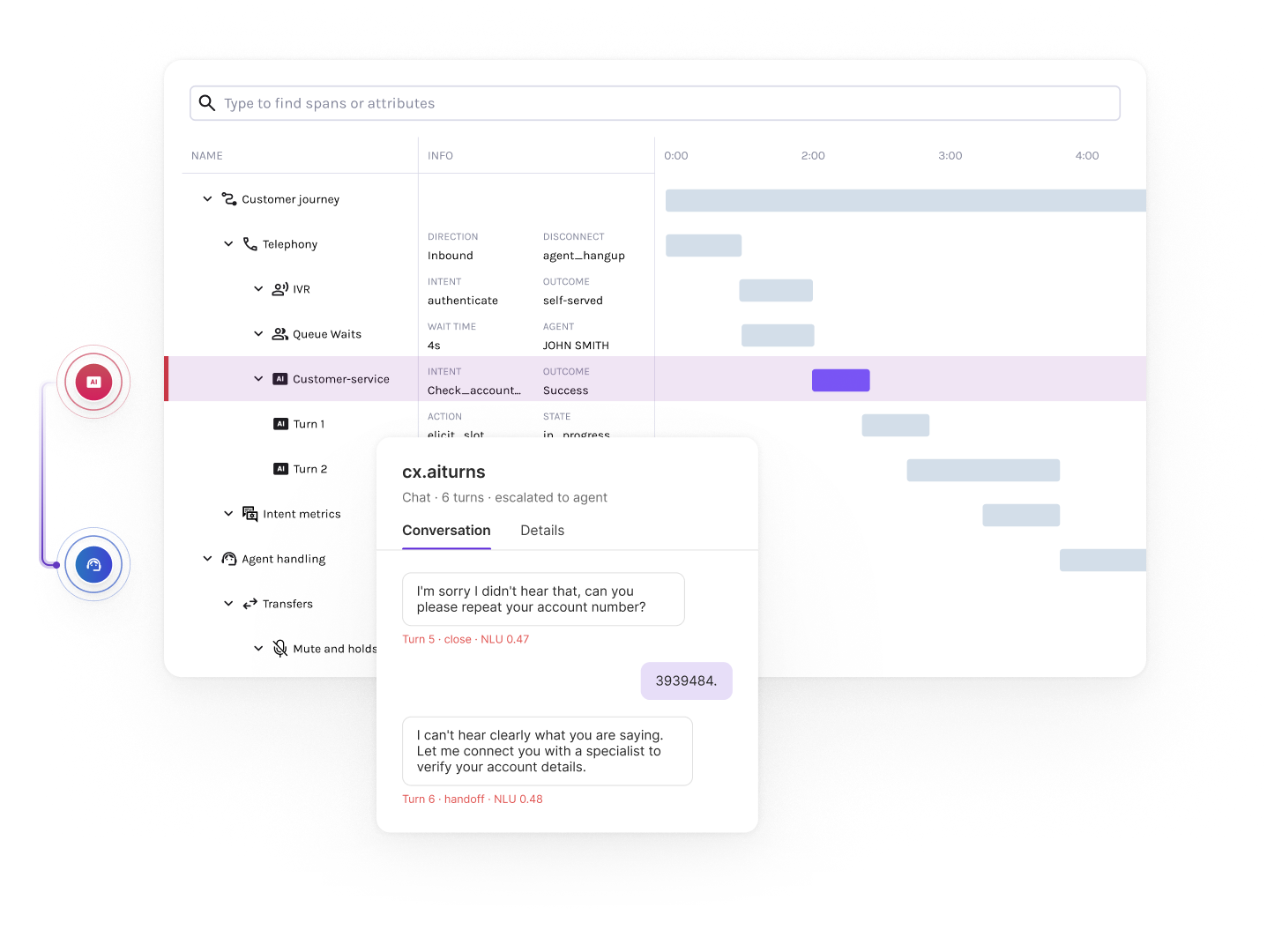
Answering them means looking at each interaction, as it happened, with enough detail to tell a human from a machine and follow what happened to each. That is a different kind of visibility from a dashboard, and it is what CX observability provides.
What CX observability changes.
I’m not claiming any silver bullet when it comes to CX observability. It will not set your service level for personal AI agent callers, fix your forecast or decide who gets the save offer. Those are your decisions. What it gives you is the one thing each of them needs first: knowing which contacts were machines, and what happened to them.
That is hard today because no single system holds the whole interaction. The carrier has the call record, the network team has the quality data, the AI vendor has the transcript, and the CRM might have the outcome. Each knows a small piece but none of them knows it was a customer-initiated AI agent or how it performed throughout your CX stack.
Join those pieces per interaction and the AI agent is obvious: synthetic speech, the same request back minutes later, the same details given twice after a handoff. Tag it, and every number you already report splits cleanly into human and AI agent. Everything else in this article follows from being able to make that split, and most contact centers cannot.
A simple test as to whether your CX is ready.
My view is that readiness has a simpler test. By the end of this year, every contact center leader should be able to answer two questions: what share of our contacts are initiated by customer-initiated AI Agents, and what are they doing? Most cannot answer either today, and very few have the instrumentation to try.
The impacts will be across workforce management, fraud, compliance, IT and the frontline, and each of those teams owns a piece but none of them owns all of it. A shared, evidence-level view of what is happening on every interaction is where they meet, and it should be the foundation for policy, procedure or SLA for Personal AI Agent callers.
If your volumes are modest and your customers are slow adopters, your existing reporting will hold for a while but for what it is worth, Sensor Tower put Muse at 2.8 million downloads in its first two weeks, so I doubt it will be that slow. If you would rather know before the forecast misses, start by labeling caller type at the source and reading everything else through that split.
Over the coming weeks I will dive deeper into these impacts and more. What I think will break inside the operation, and what you need to be able to see to run a contact center for a customer who never gets bored.



.png)


.svg)
.svg)