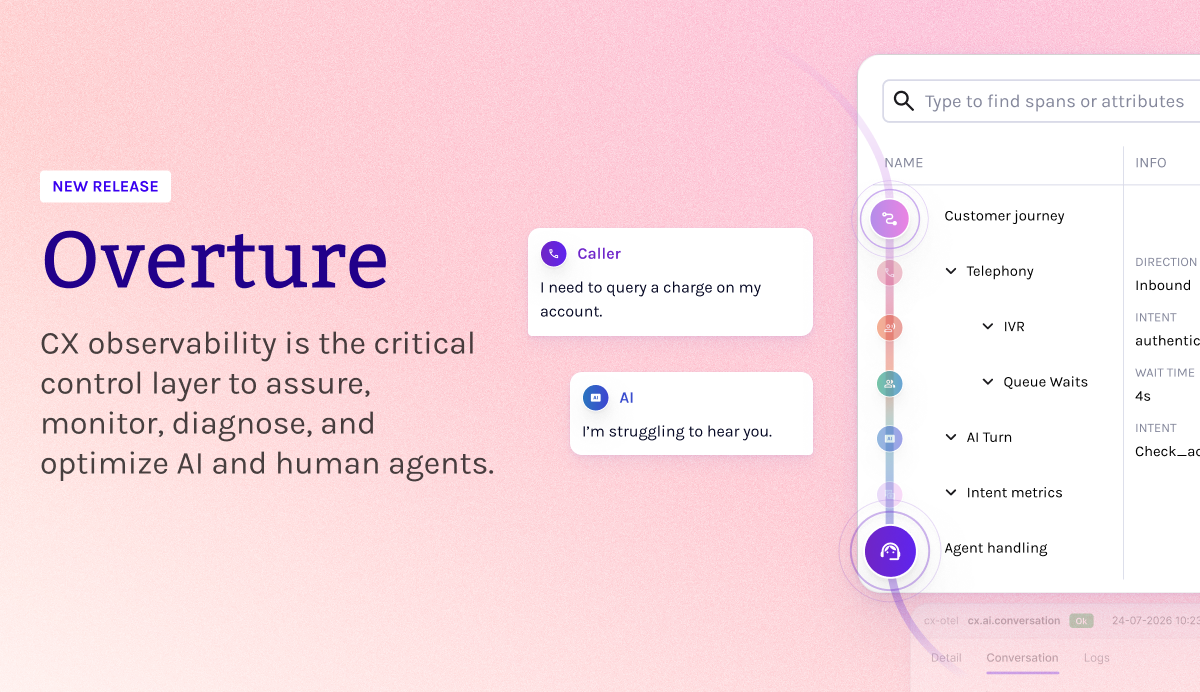
AI agents are talking to your customers in every enterprise CX stack. The deployments are running, the value of agentic AI in customer interactions showing promising payoffs. Your pre-launch testing passed, and the system went into production with a clean sign-off. Since then, a regulator or enterprise buyer has asked you for the evidence of what a customer experienced in an AI interaction.
Everything you know about your governance program is in what you designed. That doesn't translate to anything your live customers interacting with AI actually experience. Disclosure is one part of it. The whole experience is the harder question. Where does the detail of the customer experience live?
Your AI governance doesn't stop at deployment
Policies, review boards, and pre-launch testing govern intent. They set the standard the AI is meant to meet. When that agent is in production, speaking to your customers, where can you find the evidence to prove the interaction ticks every box?
- What did the AI do with a real customer?
- Did the handoff carry context?
- Did a human agent step in when it mattered?
- Did the disclosure play, or was the audio distorted?
The answers to those questions, the ones that fundamentally relate to your oversight of the customer interaction, lives in production telemetry. Your framework sets the standard, and only the record of what happened proves the AI met it, on every interaction.
What regulations now require
Between 2021 and 2025, most of the world wrote its first AI rules. The EU AI Act, South Korea's AI Basic Act, Japan's AI Promotion Act, and voluntary frameworks like the OECD AI Principles, the NIST AI Risk Management Framework, and ISO/IEC 42001 gave organizations a way to govern the AI they built.
Since 2025, autonomous agents have been handling whole interactions on their own, and governance has had to follow them into production.
In January 2026, Singapore issued the world's first governance framework for agentic AI focussing on live action control: limit how far an agent acts on its own, insert human checkpoints, monitor continuously.
The frameworks set expectations, but the enforceable laws are close behind. They converge on two duties. Tell people when they are dealing with AI, and be able to prove what the AI did.
The world map is uneven in the clear approach. The American state of Texas enforced its own Responsible AI Governance Act in January 2026, requiring a clear, plain-language disclosure before or during any AI interaction with a consumer. The Federal Communications Commission (FCC), an independent U.S. government agency, has treated AI-generated voice as "artificial" under the Telephone Consumer Protection Act (TCPA) since February 2024. That means outbound voice AI needs prior express consent, caller identification, and an opt-out.
The EU AI Act set the pace for transparency in August 2026, with fines up to €15 million or 3% of worldwide turnover. Disclosure is per interaction, and the obligation binds any provider or deployer serving EU customers, wherever they are based.
That record is hard to produce. A customer moves bot to human to bot, through transfers, handoffs, callbacks, and channel switches. In CX voice AI, barge-in lets the caller talk over the greeting, and a disclosure the customer talks over effectively never happened. Where does the proof of that interaction live?
Who's watching the whole journey
Vendor tools report on their own slice. AI monitoring tells you what the model did. CCaaS reporting tells you what the outcome was. The interaction between them: what the AI decided, what the system did next, and what the customer experienced as a result. That interaction is what emerging AI governance frameworks now ask you to prove.
Operata records it, threading telemetry from the AI agent, the CCaaS platform, telephony, WebRTC, and the backend APIs and tools into one timeline for a single journey overview. You get a control plane of the customer's actual experience.
Open any interaction and you see the AI reason turn by turn, its confidence rise or fall, and the downstream API that stalled and left the customer in silence while the call was marked "completed." You tell a legitimate escalation from a misroute, and you see two handoffs with the same intent produce different outcomes. Where one tool can tell you the disclosure played, Operata gives you the proof of whether the customer heard it.
Evidence for the questions governance asks
Emerging frameworks differ in the detail. But, the jobs they hand a governance owner are consistent, and Operata is the proof layer.
Catch failures before your customers do. Operata monitors every production call and surfaces issues as they happen, including the API and tool-call latency that stalls a response and leaves the customer waiting.
Prove what actually happened. An auditable record sits behind every interaction. See the whole journey from AI through queue placement, agent handling, transfer, and resolution, and verify the containment data underneath it: disconnect reason, intent state, NLU confidence, queue events, hold time, and whether the disclosure played before the first substantive turn.
Show human oversight worked. Classify what the AI contained and what it escalated, and quantify the containment rate. Read each transfer against the intent design to tell a legitimate escalation from a misroute, and confirm context survived the handoff in both directions.
Proof it performs. Baselines and cohort comparison gives you the detail across NLU, utterances, and intents. Spot repeat and failed self-service interactions and what they share, and catch the day a prompt change or voice swap drops disclosure.
Where Operata fits
Operata is not a governance platform. Risk assessments, policies, review boards, and standards stay with you. What Operata holds is the proof beneath them: the trace to reconstruct any interaction, real-time monitoring to catch failures live, baselines to measure performance against policy, and logs retained to your obligations. It is a shared, independent record that spans every vendor, measures every component against the same standard, and is owned by you, not the vendors serving it.
Where you require continuous monitoring and performance evaluation, Operata is how you evidence it, at the interaction level. That evidence is what lets you put AI in front of customers and stand behind it. It turns "we disclose" from a policy claim into a measurable, per-call standard. Collect the evidence now, and the rules land on a system you already run.
Why not test your production AI to see where your oversight dips? Talk over a greeting, escalate to a human, then ask to be routed back to the automated queue. Then query those interactions for the evidence. What you can't find is your evidence gap.
Prove it worked, with Operata.






.png)
.svg)
.svg)