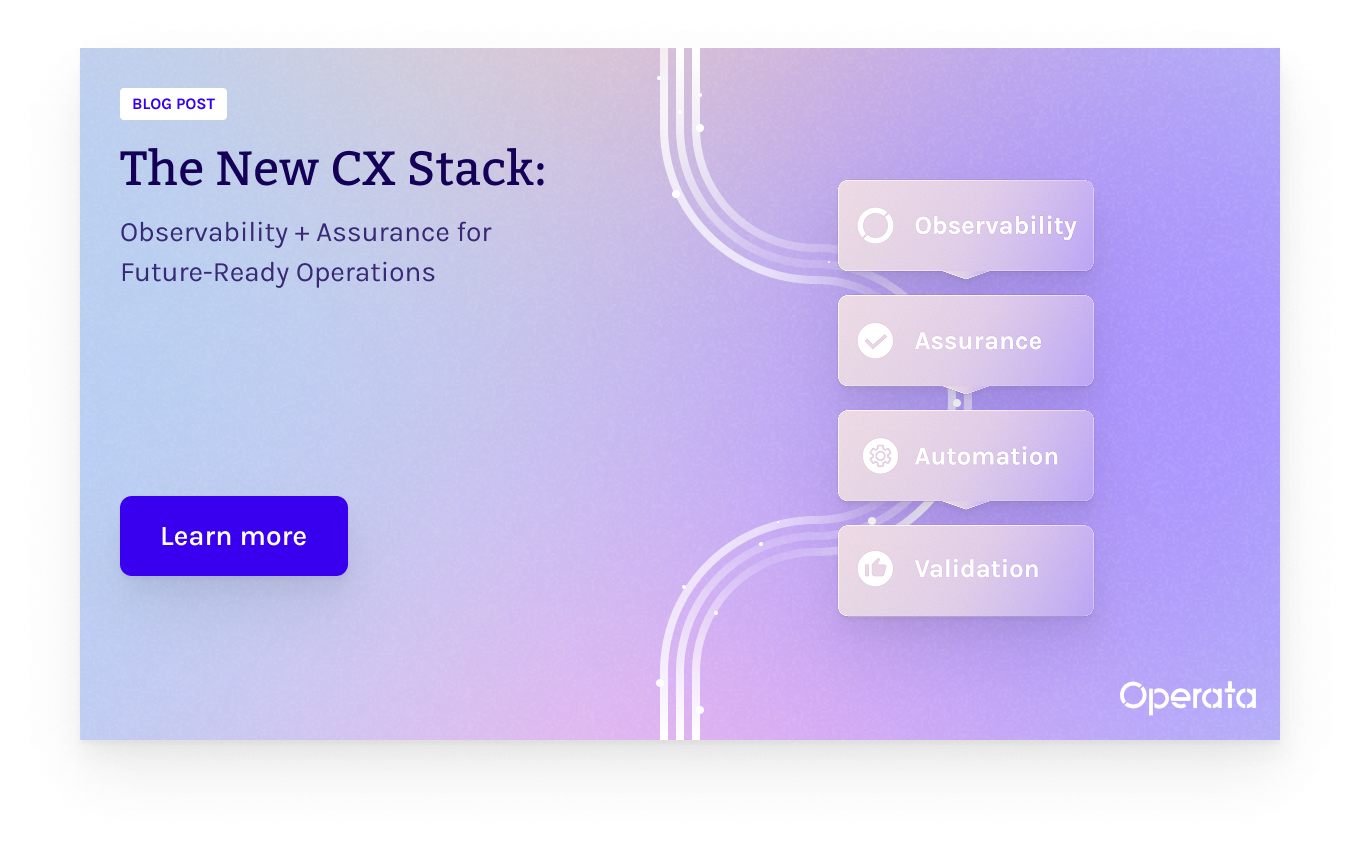
Modern contact centers must move fast and stay safe. To do both, architecture must change from a collection of point tools into a coherent learning system: detect what’s actually happening in production; turn those lessons into prevention; automate temporary mitigations; and keep improving. That’s the new CX stack.
Principles of the new stack
Detect widely: instrument production traffic and agent endpoints so you see real customer journeys and the edge cases that tests miss.
Prevent reliably: translate high-value discoveries into deterministic regression tests and CI gates so fixes don’t regress.
Automate appropriately: apply automated mitigations (rate limits, routing adjustments, temporary rollbacks) when an incident needs immediate containment.
Learn continuously: use production evidence to refine tests, models and runbooks so the system gets smarter over time.
The feedback loop
➞ Observability discovers a recurring production failure.
↳ Engineering and QA reproduce the failure as a deterministic test.
↳ The test runs in CI to prevent regressions.
↳ Observability validates the fix in production.
↳ Automation applies mitigations until the fix deploys.
↻ Repeat.
This loop turns emergent, “unknown unknown” failures into deterministic, preventable items, raising operational maturity and letting organizations scale change safely.
Operata enabling the loop
Operata intentionally blurs observability and assurance: observability detects problems and produces the context required to create effective synthetic tests; assurance then prevents recurrence, and the cycle repeats. The platform provides contextual telemetry, agent endpoint signals, per-call audio metrics, CCaaS events, and business outcomes, so discoveries include the who, what, when, and why needed to make tests reliable and actionable. By turning production evidence into deterministic tests and CI gates, Operata closes the loop between detection and prevention, enabling teams to move from firefighting to continuous improvement with measurable outcomes .
Example flow in practice
- Observability surfaces a morning spike of IVR timeouts for Queue Y tied to a third-party payment gateway. The alert includes call IDs, affected customers and agent telemetry.
- Ops isolates the pattern and hands the trace to QA. QA writes a synthetic regression that simulates payment gateway throttling under realistic timing.
- CI enforces the new test. Engineering implements backpressure handling and a temporary routing mitigation is applied automatically to reduce impact.
- Observability confirms the fix in live traffic and removes the mitigation. The new test prevents future regressions, and the organization has one fewer unknown to worry about.
Business impact
Organizations that operationalize this loop see concrete benefits: shorter MTTR because evidence is rich and actionable; fewer customer-impact incidents because fixes are codified into CI; and more productive QA and engineering teams who spend less time recreating production problems and more time delivering value. The result is measurable: lower churn, higher CSAT and a clearer ROI on remediation investments.
Practical steps to adopt the new CX stack
- Instrument the whole flow: agent endpoints, CCaaS events, carrier/network traces and business outcomes.
- Define experience-centric SLOs and tie alerts to customer impact.
- Ensure observability outputs include call IDs and contextual metadata so tests can be authored reliably.
- Build short feedback cycles: discoveries → tests → CI → production validation within a sprint cadence.
- Automate temporary mitigations and runbooks to contain impact while engineering fixes the root cause.
Don’t build a CX stack from isolated tools, build a learning system that detects, codifies, automates and improves. Observability should teach assurance what to test, and assurance should prevent recurrence. Operata was designed to be that observability teacher: collecting per-call evidence, enabling test generation, and validating fixes in production so your operations get smarter every day. Want help designing a feedback-driven CX stack and converting production discoveries into CI-enforced tests? Get in touch and we’ll map a pragmatic rollout for your teams.





.png)
.svg)
.svg)