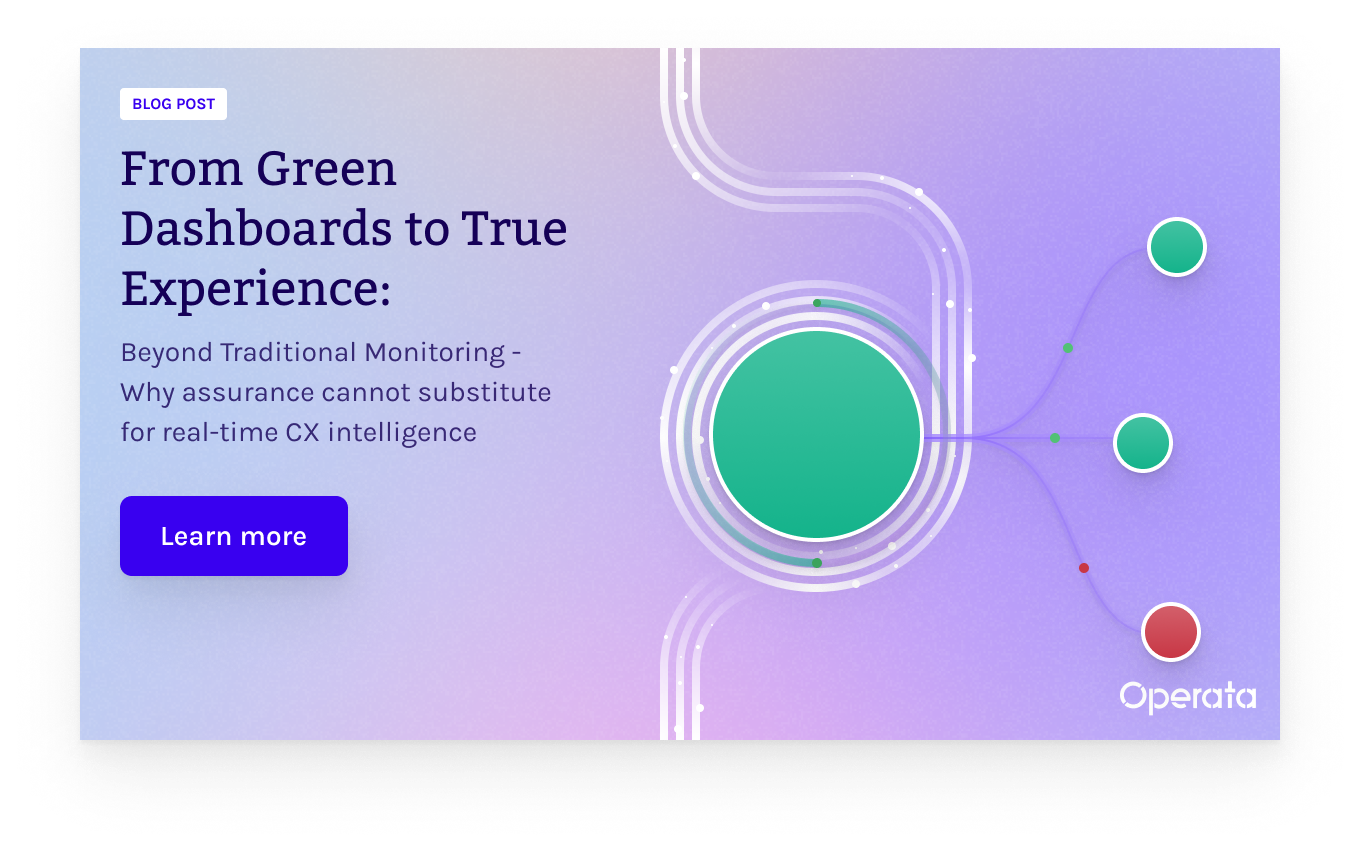
The “green” illusion
Traditional infrastructure monitors do a valuable job: they track CPU, memory, error rates and service health. But modern CX spans many layers, carrier paths, CCaaS platform events, agent endpoints and AI models, and those layers can all look healthy while customers suffer. The missing capability is correlation: the ability to join telemetry across the stack and translate technical signals into customer impact.
Monitors report component-level metrics by design. Each silo can be “green”, while the end-to-end experience is poor because customer experience is an emergent property of multiple interacting systems: a carrier route combined with an agent’s home Wi-Fi and a specific headset model can produce degraded audio even though each component’s dashboard is nominal. Fragmentation also hides context: a spike in CPU on a server may be irrelevant, while a small increase in packet loss for a single carrier can affect a high-value queue and can cause enough friction to drive customer churn. The result is a dangerous illusion: dashboards say “everything is up” while CSAT and business outcomes decline.
What true experience measurement requires
End-to-end correlation collects and joins telemetry from call initiation through resolution across agent endpoints, telephony, CCaaS events, carrier and network traces, and third-party services so you can trace a customer journey end-to-end. Outcome-oriented SLOs: define service levels around customer experience, MOS thresholds, acceptable transfer rates, successful IVR completion percentages, instead of purely infrastructure metrics. Contextual alerts surface incidents with the right queues, segments, and call IDs, plus the probable root cause, so responders act on real impact rather than getting distracted by noise.
Business upside
When teams prioritize fixes by customer impact rather than server severity they get faster ROI on remediation. Targeted investment replaces blanket spending: you can justify a headset refresh for an agent population that drives high-value revenue, negotiate carrier SLAs where call quality matters most, or redesign an IVR prompt that causes transfers for premium customers. This reduces churn, improves CSAT and focuses engineering time on changes that move the business needle.
Operata’s capability
Operata unifies agent, telephony, CCaaS, network and business signals into a single pivot so IT and Ops answer the same question: “Who is being impacted and why?” By instrumenting the agent and aggregating call-level telemetry, Operata moves teams from isolated green metrics to prioritized, customer-impact remediation. Operata captures per-call audio metrics, agent device/browser telemetry, CCaaS events and business outcomes and correlates them to present actionable evidence and insights, not simply alerts, enabling teams to triage and fix faster with confidence.
Practical steps to move from green to true experience
- Instrument the edge: deploy lightweight collectors on agent endpoints to capture CPU, browser events and headset metadata.
- Collect call context: ingest per-call MOS, jitter and packet loss alongside CCaaS event timelines.
- Define experience SLOs: set SLOs around MOS, IVR completion and transfer rates for business-critical queues.
- Correlate automatically: surface incidents with affected customers, queues and likely root causes so remediation is prioritized by impact.
- Convert fixes into prevention: convert high-impact production discoveries into regression tests and CI gates so the next release doesn’t reintroduce the problem.
Green dashboards are necessary but not sufficient. True CX reliability means measuring the customer outcome, not the component state. Observability that correlates agent, network, platform and business signals is the only reliable way to prioritize fixes that improve customer experience. Operata gives you the instrumentation, correlation and actionable insights to redefine SLOs around what matters most for your operations and customers. If you want to move from point-in-time dashboards to real-time customer outcomes, Operata can help you move from high-level dashboards to detailed, actionable insights and root cause identification. Get in touch to see the difference.
FAQs
Q: Why aren’t infrastructure metrics enough?
A: Because they don’t show who or what is impacted across the customer journey; experience emerges from multiple systems.
Q: What’s an experience SLO?
A: An SLO defined in customer terms (e.g., % calls with MOS > 4.0 or % IVR completions) rather than CPU or latency.
Q: What’s the fastest improvement an org can make?
A: Instrument agent endpoints, many high-impact problems originate at the agent.





.png)
.svg)
.svg)