Test data: depth and determinism
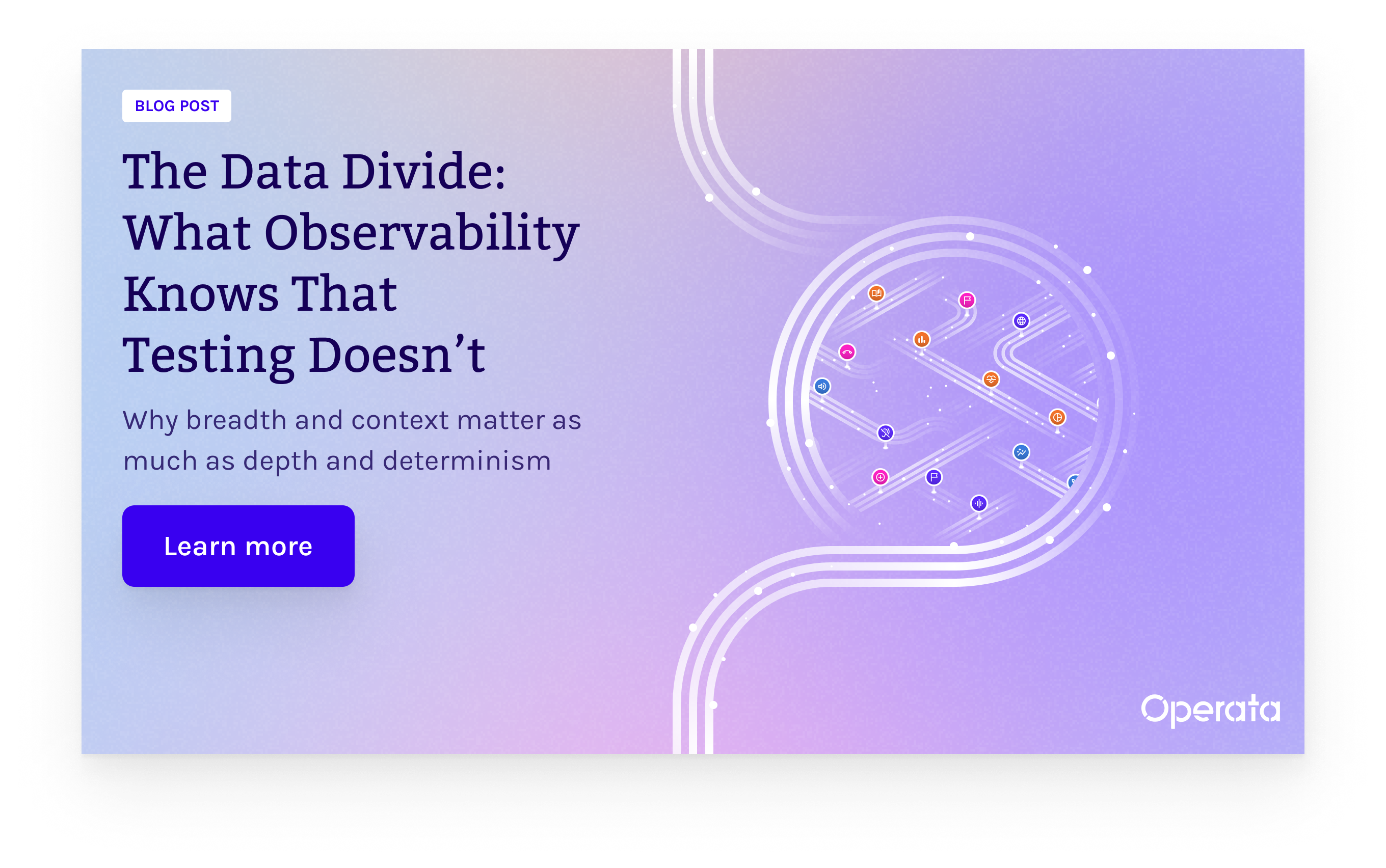
Testing and observability produce fundamentally different data. Tests give depth a focused, reliable signal for a known flow. Observability gives breadth, rich, contextual signals across every interaction that reveal patterns and rare failure modes. Understanding this “data divide” changes how you design tooling, assign ownership and measure impact.
Automated tests produce structured results: pass/fail outcomes, step-level timings and logs. They are small, reliable datasets where a failing test is immediately actionable and repeatable. Tests are ideal for CI gating, capacity verification and proving that a known change won’t regress an expected flow. For engineering-driven problems that have a clear reproduction path, tests are the right hammer.
Observability data: breadth and context
Observability records multi-attribute telemetry at scale: per-second MOS, jitter, packet loss, agent CPU and browser events, IVR path sequences, AI confidence scores and business outcomes like CSAT and abandon rates. This breadth surfaces cohort-specific issues, transient carrier effects and emergent interactions between components, which sort of problems deterministic tests rarely expose.
How observability changes problem-solving
Observability shifts troubleshooting from isolated incident response to data-driven pattern discovery. Instead of reacting to one-off failures, teams can:
- Identify an ISP that causes recurring audio problems for agents in a specific office.
- See that a particular headset model correlates with distorted audio and longer handle times.
- Detect AI drift affecting a customer segment and trace it to a recent model update.
These discoveries let you prioritize engineering work by actual customer impact, not by which dashboard alarm is loudest.
Operata’s analytics scale
Operata is built to collect and analyze billions of telemetry points, apply ML-based anomaly detection, and surface prioritized signals to teams so they can focus on high-impact fixes. By correlating per-call telemetry with agent endpoint signals and business KPIs, Operata turns noisy telemetry into precise, actionable evidence, enabling faster MTTR and smarter investment decisions. Operata’s platform also ingests “every second of every call”, so context is never lost during triage; you get both the breadth and the call-level detail required to resolve complex issues quickly.
Practical implications for teams and tooling
- Keep deterministic tests for CI and critical-path verification as they prevent regressions.
- Invest in per-call observability to catch edge cases, cohort regressions and production-only behavior.
- Convert high-impact observability discoveries into regression tests, then enforce them in CI to prevent recurrence.
- Use ML and analytics to prioritize signals so responders act on business impact, not metric noise.
Testing tells you whether known flows work. Observability tells you what’s actually happening at scale and why it matters. Use both: test to codify fixes and observe to uncover the unknowns. If you want help turning your telemetry into prioritized action, Operata can show the way to instrument the edge, correlate across layers, and focus engineering on what moves the customer needle. Get in touch to start turning your data divide into a competitive advantage.
FAQs
Q: Which should I invest in first: testing or observability?
A: Both. Start with solid tests for critical paths, then instrument production so tests reflect reality and new failures become test cases.
Q: How do I avoid observability noise?
A: Use analytics and impact-based prioritization to surface signals that affect queues, cohorts or revenue; convert the highest-impact discoveries into tests.
Q: What telemetry matters most?
A: Per-call audio metrics, agent endpoint signals, CCaaS events, AI confidence/misclassification signals and business KPIs.





.png)
.svg)