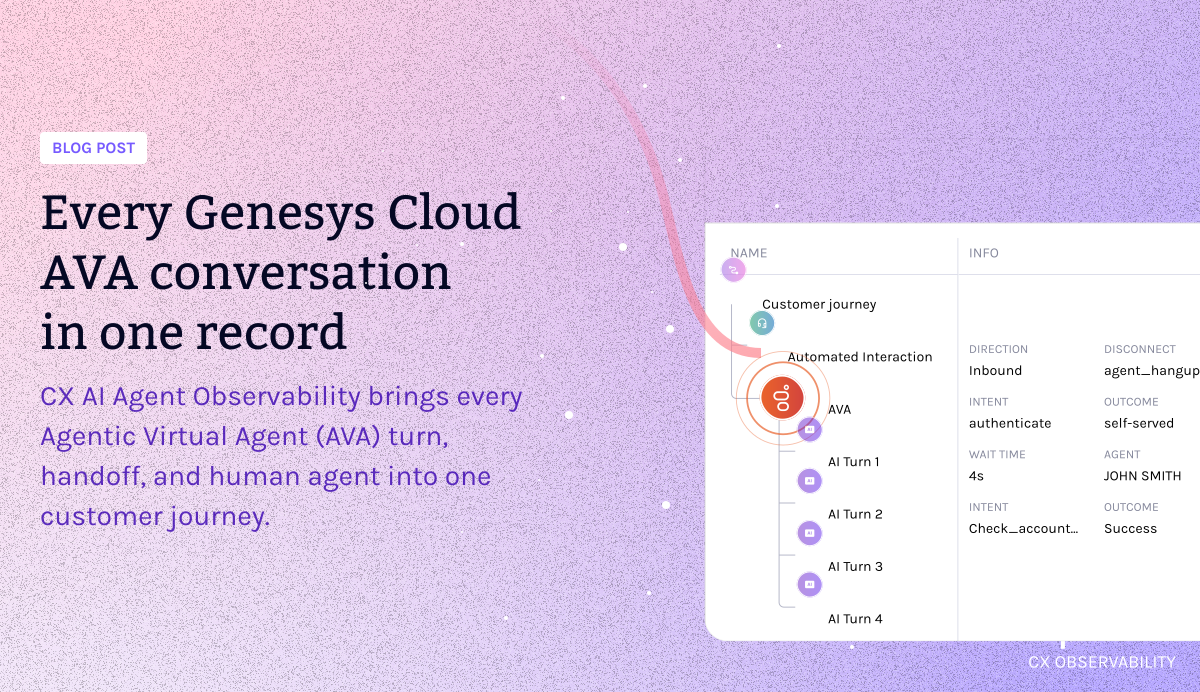
The investment case for Voice AI is all wrapped up. Deepgram’s 2025 State of Voice AI report puts it plainly: 67% of organizations consider Voice AI foundational to their products and strategy. 84% plan to increase budgets in the next 12 months. This isn’t an emerging technology category. It is core infrastructure for a modern contact center.
However, there’s a gap in Voice AI, where your investment is flying blind. Your AI tools tell you the model is working. They don't tell you whether the customer was served.
80% of organizations surveyed have deployed some form of voice agent. Only 21% report being “very satisfied” with their technology. One in five think it’s working the way they need it to.
Operata is the world's first CX Observability platform, built to cover every second of the journey your AI tools can't see. Organizations running Voice AI without it are calling something foundational that they're only half-watching.
Voice AI is delivering, but not all the way to the customer.
As CX complexity grows, so does the risk embedded in it. Advancements in Large Language Models (LLMs) have significantly enhanced the capabilities of AI customer service. The old world ‘conversational AI’ that could cope with a simple scripted back and forth, has given way to the AI Voice Agents. These powerful AI bots can not only make or take calls autonomously, they also understand customers' wants, handle it and hang up. No human required.
In the modern contact center, built on multi-vendor stacks, there's a category of failure sitting between "the AI worked" and "the customer was served." It's quiet. It rarely trips an alert. And it's eroding the ROI of AI Voice Agent deployments.
For more and more businesses deploying Voice AI at scale, the goal is straightforward. Contain more calls in self-service, reduce handle time, and free human agents for the complex work only they can do. When it works, the ROI is real. At scale, even modest improvements in AI customer service translates to serious savings.
But what proof do you have that it's working? Not just that the bot gave a contextual response, but was it the response the customer asked for. If the bot can’t hear the customer stating their account number over, and over, and over again, what metrics exist to measure that interaction that then escalates to a human agent anyway?
Look at what your AI monitoring captured, and the answer is: nothing. The model performed correctly. The response was accurate. Every signal says the interaction succeeded. Your customer says otherwise.
Deepgram's data reinforces where the failure is actually happening. 72% of organizations cite performance quality (voice quality and conversational flow) as the most critical barrier to deploying Agentic AI capability. The delivery chain. The infrastructure between the AI and the customer's ear. That's where Voice AI is breaking, quietly, in deployments that every AI monitoring tool is reporting as healthy.
Your AI monitoring watches the model, it doesn't watch the call.
Alongside the wave of Voice AI adoption is a wave of AI monitoring tooling, and it comes with genuinely useful metrics.
What they can't tell you is what happened between the model and the customer. Or between the customer's mouth and the model's input. Whether audio arrived degraded before transcription even began. Whether network conditions added two seconds that registered as a dropped call. Whether the handoff to a human agent carried context, or whether the customer had to start over.
The platforms delivering Voice AI capability are building genuinely impressive technology.
But, they were never built to measure the quality of an end-to-end call. Those live outside what your AI tools can see. They aren’t model problems, and they won’t surface in the “eval layer” of AI engineering tied to whether the reasoning is intact, and whether outputs are accurate.
Operata’s analysis of 148,000 calls tied to service tickets found that 54% of issues traced back to audio problems. Failures that occurred before the AI ever had a chance to respond. None of those failures would appear in AI monitoring. Every one of them shows up in CX Observability.
AI monitoring tells you what the model did. CX Observability tells you what the customer experienced. Right now, most organizations are only measuring one of them.
If the audio is bad, the transcription is bad. The AI never had a chance.
Human conversation runs on rhythm. A half-second pause in a voice interaction doesn't register as a technical anomaly. It registers as something wrong.
Voice AI platforms know this. The best of them have engineered response speed, and it shows. But latency isn't just a model problem. It's a delivery problem. And the delivery chain, network conditions, media processing, telephony carriers, the distance between a cloud endpoint and a customer's phone, sits entirely outside the model.
When that chain adds friction, customers don't wait to see if the next response is better. Every additional second of latency drops satisfaction, and once response time crosses a second, 67% of callers escalate to a human agent.
When those calls translate to agent handling time, and were budgeted as self-service, you’ll feel it in the balance sheet. And unless you’re measuring the right things, you won't know why.
That's what CX Observability does for Voice AI. It covers the journey your AI tools can't see: from the moment a customer speaks, through every system their call touches, to the moment their issue is resolved.
The observability gap.
AI monitoring tells you the engine is running. CX Observability tells you whether the passenger arrived. Both matter. But when the ROI conversation happens and the business needs to know whether its Voice AI investment is actually delivering, the answer lives in the latter.
You can’t fix what you can’t measure, and that’s where Voice AI deployments are flying blind right now.
Operata has built the CX Observability layer so that you can see the whole picture. To cover the journey your AI tools don't see: from the moment a customer speaks, to the moment their issue is resolved, across every system their call touches.
The organizations that get the most from Voice AI won't just have the best models. They'll have full visibility across every second of every call. That’s CX Observability. That’s Operata.
We’re building out this layer of observability, where human agents and AI agents handoff and what happens between them. Want to become a design partner, to extend that intelligence into the AI layer? Click here for more information.






.png)
.svg)