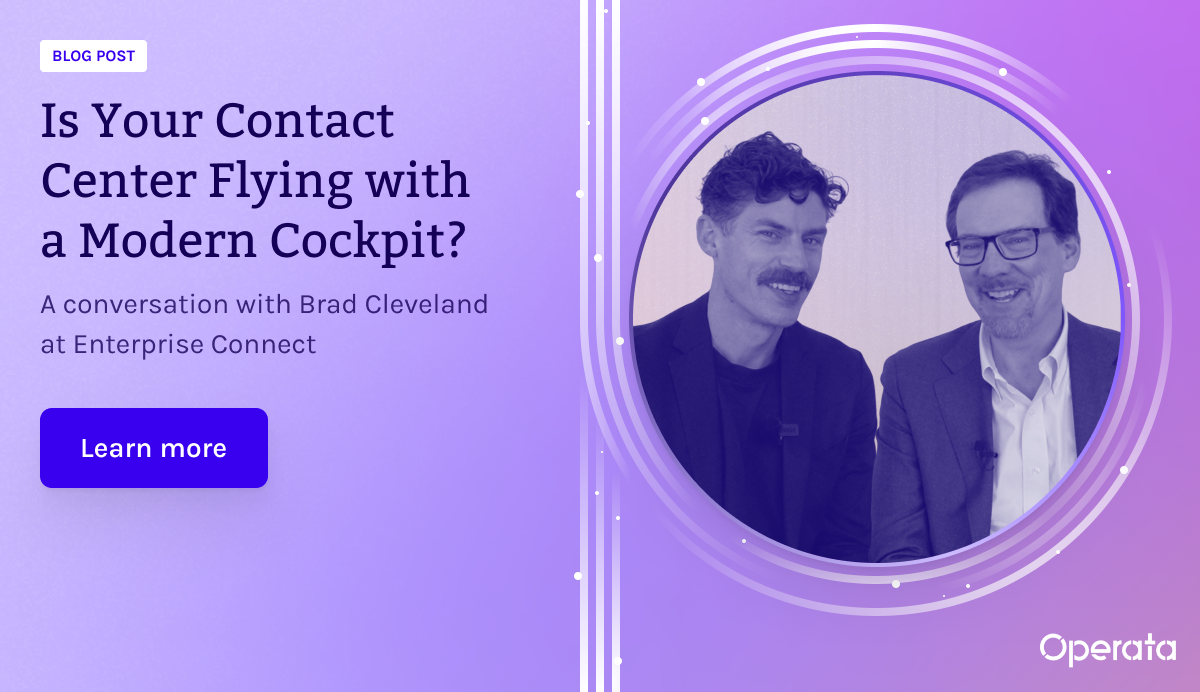
What does piloting a vintage Spitfire have to do with running a modern-day contact center?
More than you might think.
At Enterprise Connect, I sat down with Brad Cleveland, one of the most respected voices in customer experience, author of Call Center Management on Fast Forward, and, as I recently discovered, a licensed private pilot with an impressive collection of cockpit stories. Brad has flown everything from a 1923 biplane to a P-51 Mustang to the Concord, and he's ridden in the cockpit of a Qantas 747 between Auckland and Melbourne.
When I mentioned that I'd been playing with the idea of using the pilot analogy to explain CX observability and struggling to find someone who actually flew to road-test it, Brad lit up. What followed was one of the most clarifying conversations I've had about what observability really means in a contact center context, and why so many organisations are still flying blind.
The Pre-Flight Check: Assurance vs. Observability
Brad walked me through what happens before a plane ever leaves the ground. First, there's the walk-around, a visual inspection of the aircraft's surface areas, looking for anything out of sorts. Then, in the cockpit, there's a detailed, dialled-in checklist. Instruments. Avionics. Every system that needs to work.
"It's a very dialled-in checklist for any type of aircraft," Brad explained. "You go through, in many ways, a similar checklist where you're looking at instruments and avionics and all the things that need to work like they're supposed to."
In CX terms, this is assurance. It's the testing phase, the pre-deployment checks, the synthetic monitoring, the verification that everything should work before a customer ever picks up the phone. You believe the plane will fly.
However, assurance is only the beginning.
In the Air: The Difference Between Monitoring and Observability
Once you're airborne, the job changes entirely.
Brad described two categories of in-flight information that I think map perfectly onto how we should think about contact center operations.
The first category is binary checks, yes or no, with no grey area. Are you on the right frequency? Is the landing gear down? Are you on the correct runway? "There are no degrees," Brad said. "It's yes or no." Get these wrong and the consequences are immediate and serious.
The second category is finesse, the feel, the touch, the adjustments that separate a smooth flight from a bumpy one. It's not a matter of pass or fail; it's about quality and calibration.
In the contact center world, this distinction is immediately recognisable. Monitoring covers the binary layer, such as whether the agent's microphone is connected. Is audio flowing? Is the call reaching the right queue? These are your yes/no dials.
Observability covers the finesse layer: Is audio quality degraded because an agent is using their laptop mic instead of a headset? Is latency creeping up in a way that's technically "within spec" but making conversations feel halting and frustrating? Is there a pattern of one-way audio that only shows up in calls routed through a specific carrier leg?
Those nuances don't show up when you check one dial in isolation. You only see them when you're looking at the whole instrument panel, together, in real time.
The "Too Many Dials" Problem
Here's the challenge every pilot and every contact center operations leader faces: how do you watch all the instruments at once?
Brad remembered asking this exact question before he got his license. The answer, he told me, is the same whether you're in a 1923 biplane or the cockpit of a Concorde.
"There are some instruments right in front of you," he said. "Airspeed, altitude, rate of descent or climb, engine information — if you're watching those key things together, you can make sense of what's happening. A modern jet has a huge amount of additional data available, but you look at that as you need to. The primary view keeps you oriented."
This is where the analogy gets really sharp. Knowing your altitude is one thing. Knowing your altitude while also seeing an incoming weather system, a restricted airspace ahead, and a fuel warning is something else entirely. It's that surrounding context that transforms a reading into a decision. Without it, you're reacting. With it, you're anticipating.
This is precisely the problem CX observability is designed to solve. Today, contact center technology is deeply fragmented: telephony, CRM, workforce management, analytics, network infrastructure, cloud platforms. Each generates its own stream of data. Each has its own dashboard. Each tells part of the story. But no single tool connects them into a picture that actually drives action.
A supervisor seeing a spike in average handle time in isolation can't act with confidence. But if that same signal is sitting alongside a network latency warning, a cluster of calls from a specific region, and a recent IVR change, suddenly the root cause is visible and the right response is obvious. That's the difference between monitoring and observability: not just what the dials say, but what they mean together, in the moment.
Brad put it simply: "If he or she has right in front of them the information they need from all these sources and delivered in a way that's easy to interpret in real time — that's very powerful."
The Modern Cockpit Is Getting Simpler
One detail Brad shared stuck with me. In the early days of commercial aviation, cockpits were chaotic. Hundreds of individual dials, gauges, and switches spread across every surface. Aircraft carried a third crew member a flight engineer, specifically to monitor all of this information.
Modern cockpits have changed dramatically. The information is still there, but it's integrated, prioritised, and presented cleanly. The cognitive burden on the pilot has been reduced without sacrificing depth of insight.
"The modern cockpit, even in the most sophisticated aircraft, is much simpler and much cleaner in layout than it used to be," Brad said. "With all these disparate dials and information, back in the day, you had to have a third pilot and an engineer just to watch all that. Now it's really laid out cleanly and in an integrated way, increasingly in front of the pilot."
That's the trajectory we need in customer experience. Right now, many contact centers are still in the "three crew members just to watch the dials" era, with separate teams monitoring telephony, IT, and operations, each with their own tooling, speaking different languages, and unable to easily correlate what they're seeing.
CX observability is the move to the modern cockpit.
Flying Toward a Better CX
The analogy Brad and I landed on is this: assurance is the pre-flight check; monitoring is keeping an eye on individual instruments; CX Observability is the onboard computer.
The onboard computer doesn't just display readings, it ingests data from every system on the aircraft, correlates it in real time, and surfaces what the pilot actually needs to act on. It's the layer between raw telemetry and human decision-making. Without it, the pilot is drowning in dials. With it, they know exactly what's happening, why, and what to do next. Observability in CX works the same way, not another screen to watch, but an intelligent system that connects the signals, finds the story in the data, and puts the right insight in front of the right person at the right moment.
Now, just as a pilot adjusts for unexpected weather, shifts in altitude, or a slight engine irregularity before it becomes a problem, CX observability lets operations and technology teams catch experience degradation early, before customers feel it, often before agents complain about it, before it shows up as a spike in handle time or a dip in CSAT.
Brad put it in terms of where the industry is heading: "We are seeing the same kind of development efforts in customer experience, the information, brought together, and laid out cleanly and in an integrated way, in front of the pilot."
The question isn't whether your contact center has data. It's whether that data is being connected, contextualised, and surfaced in time to act. It’s time contact centers stop relying on the walk-around pre-check hope strategy with a 3-person crew looking at individual dials, trying to get the picture to add up.
Until next time, and as always, hooroo.
Brad Cleveland is a global expert in customer experience and contact center management, author of Call Center Management on Fast Forward, and founder of the International Customer Management Institute (ICMI). Luke Jamieson is a CX leader and advocate for CX observability at Operata.
Check out the video of our chat on YouTube and if you want to see what the modern CX cockpit looks like? Get a demo of Operata





.png)
.svg)
.svg)