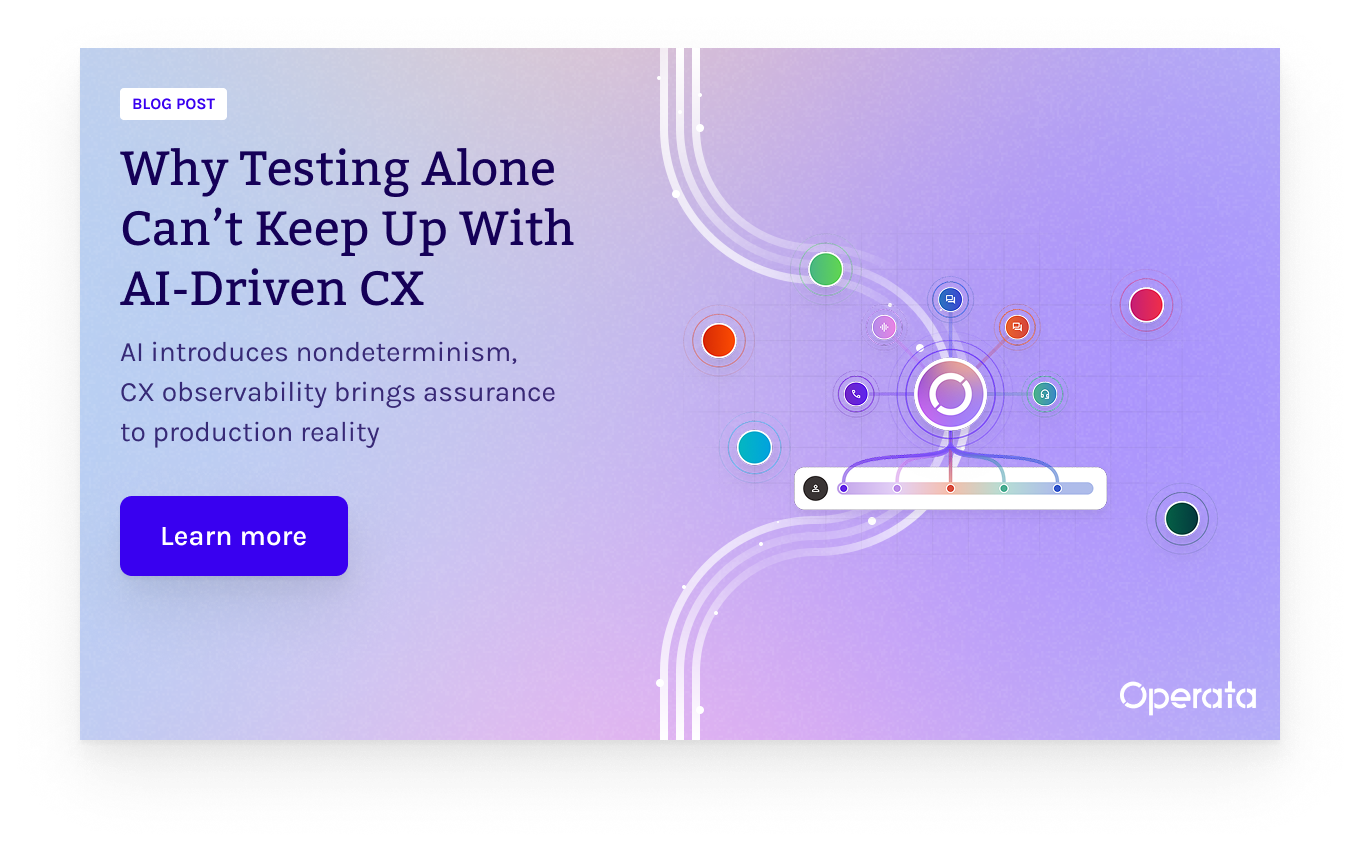
AI is rapidly moving from experimental to core contact-center infrastructure: intent detection for routing, virtual agents for self-service, summarization for agents, and real-time assist for complex tasks. These capabilities unlock huge operational gains but introduce nondeterminism: model outputs vary across accents, cohorts, background noise and real-world contexts. Static, scripted testing remains essential for safety, but it can’t validate how AI behaves in the messy variety of production traffic.
AI’s operational complexity
Models behave differently by cohort, accent, utterance length, noisy audio and under varying load. A model update may improve aggregate accuracy while degrading performance for a minority dialect or a geography with distinct speech patterns. Problems can be subtle; a small cohort regression that increases escalations for high-value customers and remains invisible to canonical test utterances. Without continuous production signals, AI regressions surface only when customers complain or KPIs slip, which is both slow and costly.
Why observability is essential for AI
Observability measures AI in the environment that matters: production. It tracks misclassification rates by cohort, confidence distribution changes after a deployment, latency distribution under load, escalation and transfer patterns, and links those signals to business outcomes like CSAT and abandonment. Observability surfaces cohort-specific regressions and correlates them with upstream factors such as, Automatic Speech Recognition quality (ASR), audio artifacts, third-party service throttles or recent model changes, enabling fast, targeted remediation rather than noisy, hypothesis-driven debugging.
An operational play
When observability finds an AI regression, teams can follow a controlled playbook: rollback the model or route a subset of traffic away; tag affected calls and extract real-world utterances for analysis; create targeted tests reproducing the regression; retrain or fine-tune models using problematic utterances and deploy in a canary; use observability to validate improvement and enforce the test in CI so the regression cannot reappear. This loop keeps AI evolution measured and incremental, turning production evidence into deterministic safeguards.
AI Clarity with Operata
Operata captures AI interaction metadata alongside technical and operational signals so teams see the full chain of cause and effect: per-call MOS and jitter, agent device telemetry, ASR confidence, model predictions, intent confidence, CCaaS events and business outcomes. That correlation is critical for diagnosing whether an issue stems from audio quality, ASR, model drift or an integration bug. By surfacing prioritized, impact-based signals, Operata helps teams decide whether to retrain models, patch infrastructure or roll back deployments and it supports converting the production discovery into a repeatable test to prevent recurrence.
Example scenario
A new intent model reduces overall latency but increases misroutes for a small regional cohort. Observability detects rising misclassification and a corresponding CSAT dip, isolates calls by call ID, ties them to low ASR confidence and to poorer agent-side audio metrics. Ops rolls back the deployment for that cohort, QA authors a targeted regression, engineering retrains the model with the captured utterances and the updated model is canaried. Observability validates improvement and the new test enters CI to guard subsequent releases.
Conclusion
AI can deliver transformational CX, but it requires production validation. Observability is the feedback loop that keeps AI improvements safe, measurable and accountable. If you’re deploying AI in contact centers, Operata provides the telemetry, correlation and analytics to manage model risk, shorten detection-to-fix cycles and enforce prevention. Want help instrumenting your AI stack and turning production signals into CI-enforced safeguards? Get in touch.
FAQs
Q: Can tests detect model drift?
A: Only for scenarios you anticipate. Tests can’t cover the long tail of real utterances or production noise; observability detects drift across real traffic.
Q: How fast should teams act on AI regressions?
A: High-impact regressions should be triaged immediately, roll back or isolate traffic, capture failing calls, create targeted tests and remediate in the same sprint when possible.
Q: What telemetry is critical for AI governance?
A: Per-call audio metrics, ASR confidence, model prediction and confidence, CCaaS event timelines, agent endpoint telemetry and downstream business KPIs.





.png)
.svg)